✿ THE STUDENTDAYS JOURNAL
Realistic Study Routine:
5 Steps for Studying in the Netherlands
Less pressure, more progress. Build a study
routine that actually fits your student life.
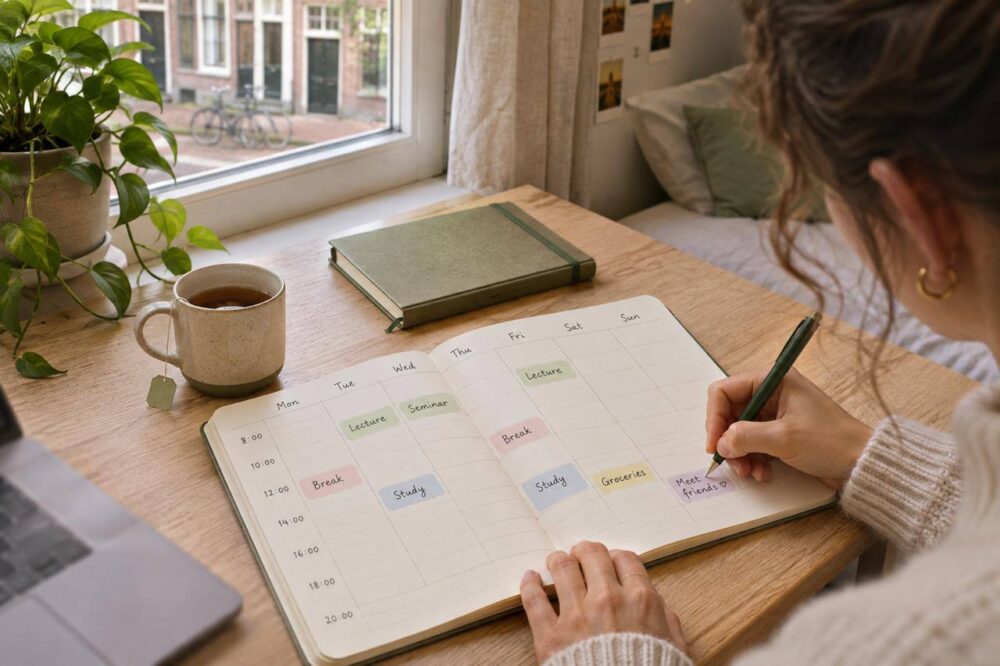
A little reminder…
A realistic study routine helps you
keep up with university work while leaving space
for everyday life. As an international student in
the Netherlands, you may also be adjusting to a
new city, studying in English and learning how to
manage your own household.
Between lectures, assignments, grocery shopping
and meeting friends, your week can fill up
quickly. A timetable that looks perfect on Sunday
may already feel impossible by Tuesday.
The aim is to build a routine you can actually
follow. These five steps will help you plan around
your responsibilities and make your study time
easier to manage.
FIRST THINGS FIRST
Start Your Realistic Study Routine
with Fixed Commitments
Before scheduling independent study, write down
the activities that already take up time. Include
lectures, work shifts, appointments and your
commute.
Remember the smaller responsibilities too.
Cooking, laundry and shopping need space in your
week, even when they do not have strict deadlines.
Once these commitments are visible, look for
realistic study periods. If you arrive home tired
after a full day of classes, a short review
session may be more manageable than three hours
of demanding coursework.
✎ LITTLE EXAMPLE
For example, you could review lecture notes
for half an hour that evening and save report
writing for a quieter morning. Plan around
your actual energy and available time.
MAKE IT MANAGEABLE
Turn Assignments into Clear Next Actions
“Work on my assignment” is difficult to schedule
because it does not tell you where to begin or
when you can stop. Break each assignment into
smaller actions.
For a report, these might include reading the
assessment criteria, finding three relevant
sources, making an outline and drafting the
introduction.
YOUR MINI ASSIGNMENT CHECKLIST
- Read the assessment criteria
- Find three relevant sources
- Make a simple outline
- Draft the introduction
Choose a specific action for each session.
“Find and read two sources” gives you a clearer
goal than “do research.”
Keep these tasks in one main place, whether that
is a notebook, a simple task app or a document.
You should be able to see your next action without
searching through several apps and messages.

LEAVE SOME SPACE
Leave Breathing Room in Your Weekly Plan
A realistic study routine needs flexibility.
Group work can take longer than expected,
a difficult topic may need another session,
or an appointment might interrupt your plans.
Avoid filling every available hour. Leave some
open time for unfinished work and unexpected
responsibilities.
If you have a deadline on Friday, aim to complete
a draft earlier so you have time to check it.
Consider which parts depend on other people,
such as receiving feedback from a group member.
When something takes longer than planned, adjust
the remaining tasks. Moving work is sometimes
necessary, but repeatedly postponing the same
task can mean that it needs breaking down further.
Your schedule should fit your life,
not the other way around.
FIND YOUR FOCUS
Make Your Study Sessions Easier to Start
Before beginning, decide what you want to finish
and gather the materials you need. Open the
assignment brief, relevant notes and working
document.
Put your phone out of reach if you keep checking
it. Close unrelated browser tabs and choose a
study location where you can work comfortably.
☼ TRY THIS
You could try a 25-minute session followed
by a short break, then adjust the length to
suit the task.
Reading a difficult chapter may need a different
pace from practising presentation slides. If
your room is distracting, try your university
library or another available study space.
Studying alongside a friend can also help,
provided you agree on when to work and when
to talk.
Use digital tools only where they solve a
specific problem. A calendar can protect study
time, while a task list can show what to do next.
REFLECT & RESET
Review Your Realistic Study Routine Each Week
At the end of the week, take ten minutes to
review your plan. Look at what you completed
and what remains.
Ask yourself:
Sunday reset ☕
- Which study sessions were easiest to follow?
- Which tasks took longer than expected?
-
Did I leave enough time for rest and
everyday responsibilities? - What should I change next week?
Make one useful adjustment. You might move
difficult work to the morning, shorten your
daily task list or allow more time for group
assignments.
Use what happened as information for your next
plan. A routine becomes more realistic when
it reflects how you actually work.

✿
Make Time for Life Beyond Coursework
Studying abroad also includes building
friendships, exploring your surroundings and
finding activities you enjoy. Give those parts
of your week space alongside your coursework.
Start your realistic study routine with a few
manageable sessions and clear goals. Keep track
of deadlines, leave room for changes and review
your progress regularly.
You do not need to organise every minute.
You need a plan that helps you begin your work
and return to it consistently.
with love, StudentDays ♡